Key Takeaways
- Across 31 randomized trials comparing therapist-guided internet CBT with face-to-face CBT, the pooled difference was g=0.02. Effectively zero.
- Half of those trials treated depression or an anxiety disorder, so it isn’t a finding borrowed from some unrelated problem.
- Video sessions hold up too. An 18-study meta-analysis found no significant difference in the therapeutic relationship compared with meeting in person.
- What predicts whether online treatment works is human guidance, not the screen. Guided programs keep people engaged; unguided ones lose them.
- Anxiety adds one wrinkle: treatment usually involves facing things, and a screen can make that easier or quietly become another way to avoid.
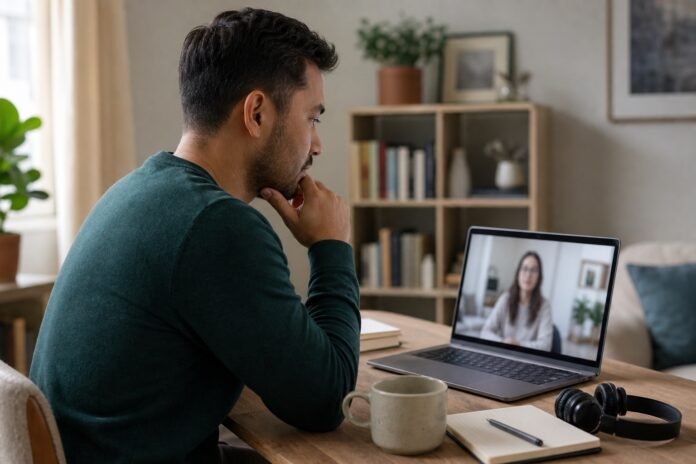
You’ve been meaning to call a therapist’s office for about seven months. Calling is the problem. Calling a stranger, at a time when someone might pick up, to explain in your own voice why you need help, is a small thing that has somehow grown to the size of a house. Then one Tuesday night you find a website where you fill in a form, pick a slot from a calendar, and nobody has to answer the phone. Two weeks later there’s a therapist on your laptop screen.
Something in you wants to know whether this counts. Whether the easy version is the real version, or a discount one you settled for because the real one was too hard. Here’s what the research says about that, where it says something less comfortable, and how to tell which of the three very different things called “online therapy” you should be booking.
“Online therapy” is three different products
Almost every argument about whether online therapy works falls apart because the people arguing are describing different things. There are three, and their evidence bases aren’t interchangeable.
Live video sessions with a licensed therapist. Same fifty minutes, same person, same conversation, delivered through a camera. It’s what most people picture, and it’s what most therapy platforms sell.
Therapist-guided internet CBT. A structured program of written modules, exercises and homework you work through on your own schedule, with a clinician reading what you submit and writing back. Less talking, more doing. It’s the format with the deepest research base, mostly out of Sweden, Australia and the Netherlands.
Unguided apps and self-help programs. The same kind of modules with no human attached. Cheap, instant, and a completely different proposition, as you’ll see shortly.
When a headline says online therapy is “just as good,” it’s almost always describing one of the first two.
The head-to-head evidence is unusually clear
Most questions in psychotherapy research come with a shrug attached. This one doesn’t.
Hedman-Lagerlöf and colleagues at Karolinska Institutet have been updating the same meta-analysis for a decade, and their 2023 version in World Psychiatry screened 5,601 records to find every randomized trial that put therapist-guided internet CBT directly against face-to-face CBT in adults. They found 31 trials covering 16 different clinical conditions. The pooled effect size was g=0.02, with a confidence interval running from −0.09 to 0.14 (Hedman-Lagerlöf et al., 2023).
An effect size of 0.02 isn’t a small advantage for one format. It’s a rounding error. The two formats produced the same results.
The detail that matters most here: half of those 31 trials were in depression or some form of anxiety disorder. This isn’t a finding about insomnia that somebody stretched to cover panic. Anxiety is one of the two conditions the evidence base is actually built on.
What about plain video sessions?
Guided internet CBT is well studied, but it isn’t what most people book. So does the evidence hold for ordinary talking therapy over video?
Fernandez and colleagues pooled 56 within-group studies and 47 between-group studies covering more than 5,000 participants. Video-delivered psychotherapy produced large improvement from before treatment to after, and when compared directly against in-person therapy the difference was negligible. Improvement was most pronounced when the therapy was CBT, and when the target was anxiety, depression or PTSD (Fernandez et al., 2021).
A separate meta-analysis of 16 studies found videoconference CBT clearly outperformed control conditions, with a pooled effect of g=−0.49 (Matsumoto, Hamatani & Shimizu, 2021). Different research groups, different methods, same direction.
If you want the broader format comparison rather than the anxiety-specific one, we cover it in online therapy vs in-person therapy.
But doesn’t the connection suffer?
That’s the objection worth taking seriously, because the working relationship between client and therapist is one of the most reliable predictors of whether therapy helps at all.
For a while the answer looked like a qualified yes. Norwood and colleagues reviewed 12 studies in 2018 and concluded that the working alliance in videoconferencing therapy was inferior to face-to-face delivery, even though symptom outcomes came out equivalent (Norwood, Moghaddam & Malins, 2018). That finding got quoted a great deal, and it’s still quoted now.
It hasn’t held up. A 2024 meta-analysis by Seuling and colleagues gathered 18 publications comparing alliance in videoconference and in-person therapy, rated by clients and by therapists. Client-rated alliance differed by a standardized mean difference of −0.09, with a confidence interval spanning zero. Therapist-rated alliance came out at 0.04. No significant difference either way, and no moderator explained the variation (Seuling et al., 2024).
So the honest summary: the early worry was reasonable, and the larger, more recent body of evidence doesn’t support it. People bond with their therapists through a screen at roughly the rate they bond in a room.
The ingredient that predicts whether it works
Here’s where the three-products distinction stops being pedantic.
Domhardt and colleagues examined the components of internet and mobile interventions for anxiety disorders specifically, pooling 34 randomized trials with 3,724 participants. What emerged as decisive wasn’t the content of the modules or the slickness of the platform. It was guidance. Guided programs improved adherence compared with unguided ones, and the gap was widest among people who were more severely affected (Domhardt et al., 2019).
That finding should reorganize how you shop. The question isn’t “is this app evidence-based.” Plenty of unguided apps contain real CBT. The question is whether a human being will notice if you stop showing up. Anxiety is very good at generating reasons to skip today’s module, and an app has no opinion about that. A clinician does.
If your budget only stretches to an unguided program, it’s still better than nothing. The honest framing is that it works best as a supplement or a holding pattern rather than a treatment plan.
Anxiety’s specific complication: exposure
CBT for anxiety disorders isn’t mostly conversation. The active ingredient in most protocols is exposure: deliberately approaching the thing you’ve been avoiding, in a planned way, until your nervous system updates its estimate of the danger.
This is where format stops being neutral and becomes a design question, and it cuts both ways.
In favor of online: your feared situations are mostly at home, at work and in your own life, not in a therapist’s office. Doing the work in the environment where the anxiety lives removes a translation step. A therapist on your phone can be with you in the supermarket in a way a therapist in an office can’t.
Against: for some presentations, the home is the avoidance. If leaving the house is the feared thing, a treatment that never requires you to leave the house can look like progress while functioning as a very sophisticated way of staying in. The same applies to social anxiety treated entirely through a screen, where the screen removes exactly the exposure you need.
We couldn’t find good head-to-head research isolating this question, so treat it as a design consideration rather than a settled finding. The practical move is to ask a prospective therapist directly: how do you do exposure work remotely, and at what point would you want me practicing outside my flat? Someone trained in anxiety treatment will have a ready answer. Someone who doesn’t is telling you something useful.
Where online genuinely wins for anxious people
Some of these advantages are specific to anxiety rather than general conveniences.
The booking friction is lower, which matters enormously when avoidance is the symptom. The waiting room disappears, and for people with social anxiety the waiting room was often the worst part. There’s no commute to a session you’re already dreading, so you’re removing an hour of anticipatory dread rather than adding one.
The therapist pool widens beyond driving distance, and for a specific presentation such as OCD, panic disorder or health anxiety, finding someone who’s treated dozens of your exact problem matters more than finding someone nearby. Our guide to anxiety in adults covers which approaches map onto which presentation.
Cost tends to be lower, sometimes substantially, and subscription platforms price differently from hourly private practice. The breakdown is in how much therapy costs in 2026.
Where a screen is the wrong call
Four situations, and none of them are about whether the format “works.”
If you’re in crisis or having thoughts of harming yourself, a subscription platform isn’t built for that. Most say so in their own terms of service. You want a service with a crisis protocol, and you want it locally.
If your situation may call for medication as part of the picture, that’s a prescriber’s decision and a separate conversation. Who does what is laid out in our comparison of psychologists, psychiatrists, therapists and counselors.
If you don’t have a private, reliable place to talk, online therapy becomes unusable in a specific way. Fifty minutes in a parked car is a real solution some people use, and it’s also worth naming as a cost.
And if you’ve already tried a course of remote treatment for the same problem without much movement, the format is a reasonable variable to change. Before you conclude that therapy doesn’t work for you, it’s worth reading what to try before you quit, because format is only one of four things that might be off.
The licensing detail nobody mentions
In the United States, a therapist generally has to be licensed in the state where you are physically sitting during the session, not where they are.
That sounds like paperwork and then abruptly isn’t. It decides what happens when you move, when you spend a month at your parents’ house, and when you travel for work. For psychologists there’s a compact called PSYPACT that lets clinicians in participating states practice across member state lines, and most but not all US states and territories now participate. California, Oregon, Louisiana, New Mexico and Alaska are among those outside it (PSYPACT, 2026). Counselors and social workers have their own separate compacts with different membership.
The practical question to ask before you book, especially if you move around: what happens to our sessions if I’m in another state for a while?
Choosing between the three formats
A short decision path rather than a matrix.
If you want a relationship with a person, and your anxiety comes tangled with life circumstances, relationships or history, book live video with a licensed therapist. That’s the general-purpose option and the evidence supports it.
If your anxiety is well defined, you like structure, and you’d rather do exercises than talk, look for therapist-guided internet CBT. It’s the format with the strongest head-to-head data and it usually costs less than weekly sessions.
If you’re waiting for an appointment, or testing whether you can tolerate any of this, an unguided app is a reasonable holding position with a known weakness, which is that you’ll probably stop using it and nobody will notice.
Platform choice is a separate exercise. We compare the two largest subscription services in BetterHelp vs Talkspace, and the fit questions that apply regardless of route are in the complete guide to finding the right therapist.
The takeaway
The thing you were worried about isn’t the thing to worry about. The screen isn’t costing you results, and the evidence on that is stronger than the evidence for most things in this field. Thirty-one head-to-head trials landing on a difference of 0.02 is about as close to a clean answer as psychotherapy research ever gets.
What’s worth your attention instead is whether a human is in the loop, and whether your treatment will eventually ask you to do the uncomfortable part rather than letting you read about it. Anxiety is patient and inventive, and it’ll happily accept a version of treatment that never requires you to approach anything.
You already did the hard bit, which was deciding to look. That form you filled in on a Tuesday night wasn’t a discount version of asking for help. It was asking for help.
Next step
Whichever format you pick, the fit questions are the same. Our complete guide to finding the right therapist covers credentials, costs and how to judge fit quickly, and if you want to know what the evidence says about therapy in general before you spend money on it, start with does therapy actually work.
Frequently asked questions
Is online therapy as effective as in-person therapy for anxiety?
On the available evidence, yes. The largest head-to-head meta-analysis found 31 randomized trials comparing therapist-guided internet CBT with face-to-face CBT, with a pooled effect size of g=0.02 and a confidence interval crossing zero. Half of those trials were in depression or anxiety disorders. Separate meta-analyses of live video therapy reach the same conclusion. The format isn’t what determines your outcome.
Do therapy apps work without a therapist?
Less well, and mostly because people stop using them. A meta-analysis of 34 trials of internet and mobile interventions for anxiety disorders found that guidance improved adherence compared with unguided programs, with the largest gap among people who were more severely affected. The content of unguided apps is often sound. The problem is that nothing happens when you drift away, and anxiety is skilled at generating reasons to drift away.
Can you do exposure therapy over video?
Yes, and there’s an argument that it’s easier, because your feared situations are in your life rather than in a therapist’s office. The caution is that for some presentations, especially agoraphobia and social anxiety, staying home is part of the problem. Treatment that never requires you to leave can feel like progress while reinforcing avoidance. Ask any prospective therapist how they handle remote exposure, and when they’d expect you to be practicing outside the house.
Is it harder to feel connected to a therapist over video?
An earlier meta-analysis of 12 studies suggested the working alliance was weaker over video, though symptom outcomes were equivalent. A larger 2024 meta-analysis of 18 publications found no significant difference in alliance rated by clients or by therapists. The more recent and better-powered evidence says connection holds up. If it isn’t holding up with a particular therapist, that’s worth raising with them directly, because it’s information about the fit rather than about the medium.
Does my online therapist have to be licensed in my state?
In the United States, generally yes. Licensure follows the client’s physical location during the session, not the therapist’s. Psychologists in participating states can practice across member state lines through the PSYPACT compact, which now covers most but not all US states and territories. Counselors and social workers have separate compacts with different membership. If you move or travel for extended periods, ask before you book what happens to your sessions when you’re elsewhere.
Sources
- Hedman-Lagerlöf E, Carlbring P, Svärdman F, Riper H, Cuijpers P, Andersson G. (2023). Therapist-supported Internet-based cognitive behaviour therapy yields similar effects as face-to-face therapy for psychiatric and somatic disorders: an updated systematic review and meta-analysis. World Psychiatry, 22(2), 305-314. (5,601 records screened; 31 randomized trials across 16 conditions; pooled effect g=0.02, 95% CI -0.09 to 0.14; half of trials in depression or anxiety disorders.)
- Fernandez E, Woldgabreal Y, Day A, Pham T, Gleich B, Aboujaoude E. (2021). Live psychotherapy by video versus in-person: A meta-analysis of efficacy and its relationship to types and targets of treatment. Clinical Psychology & Psychotherapy, 28(6), 1535-1549. (56 within-group studies, 1,681 participants; 47 between-group studies, 3,564 participants; pre-post g=0.99, negligible difference from in-person; strongest effects for CBT and for anxiety, depression and PTSD.)
- Seuling PD, Fendel JC, Spille L, Göritz AS, Schmidt S. (2024). Therapeutic alliance in videoconferencing psychotherapy compared to psychotherapy in person: A systematic review and meta-analysis. Journal of Telemedicine and Telecare, 30(10), 1521-1531. (18 publications; client-rated alliance SMD -0.09, 95% CI -0.26 to 0.07; therapist-rated SMD 0.04, 95% CI -0.17 to 0.25; no significant moderators.)
- Norwood C, Moghaddam NG, Malins S. (2018). Working alliance and outcome effectiveness in videoconferencing psychotherapy: A systematic review and noninferiority meta-analysis. Clinical Psychology & Psychotherapy, 25(6), 797-808. (12 studies; alliance rated inferior to face-to-face delivery while symptom reduction was equivalent. Superseded on the alliance question by Seuling et al., 2024.)
- Domhardt M, Geßlein H, von Rezori RE, Baumeister H. (2019). Internet- and mobile-based interventions for anxiety disorders: A meta-analytic review of intervention components. Depression and Anxiety, 36(3), 213-224. (34 randomized trials, 3,724 participants; type and intensity of guidance emerged as key factors for engagement, with guided interventions improving adherence over unguided ones, especially in severely affected individuals.)
- Matsumoto K, Hamatani S, Shimizu E. (2021). Effectiveness of videoconference-delivered cognitive behavioral therapy for adults with psychiatric disorders: Systematic and meta-analytic review. Journal of Medical Internet Research, 23(12), e31293. (16 studies, 17 intervention arms; pooled between-group effect g=-0.49, 95% CI -0.68 to -0.29.)
- PSYPACT. (2026). PSYPACT participating states map and legislation. Psychology Interjurisdictional Compact Commission. (Current list of participating states and territories; membership changes as legislatures act, so check the map rather than a secondhand count.)
Disclaimer: This article is for educational and informational purposes only and is not intended as a substitute for professional medical or mental health advice, diagnosis, or treatment. Always seek the guidance of a qualified mental health professional for any questions about your mental health or a medical condition.
If you are in crisis: In the US, call or text 988 (Suicide & Crisis Lifeline). In the UK, call 116 123 (Samaritans). Elsewhere, findahelpline.com lists country-specific services.
