Key Takeaways
- Anxiety and sleep problems form a two-way loop: anxiety wrecks sleep, and poor sleep worsens anxiety the next day.
- The core mechanism is hyperarousal, a nervous system stuck in “alert” mode, so the brain treats sleep as a threat rather than a release.
- Cortisol runs higher in poor sleepers, especially before bed and in the first half of the night, which helps explain 2am wake-ups (Vgontzas et al.).
- CBT-I (Cognitive Behavioral Therapy for Insomnia) is the gold-standard treatment, as effective as medication with longer-lasting results.
- You can’t force sleep, but you can lower the arousal that blocks it, which is what the evidence-based techniques actually target.
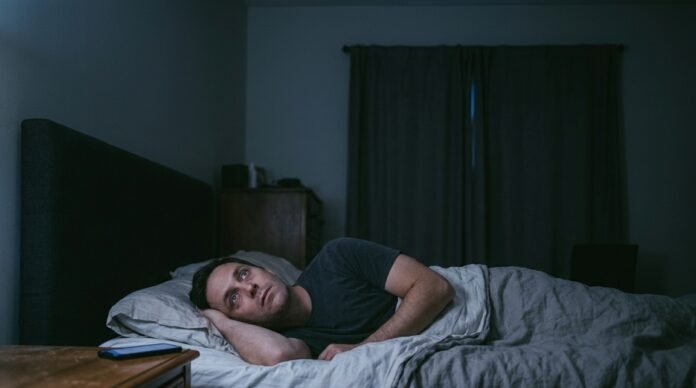
The day is finally over. You’re exhausted, you’ve wanted your bed for hours, and now you’re in it, wide awake. The moment your head hits the pillow, your brain, which was too tired to think straight all afternoon, suddenly boots up a full review: that thing you said, tomorrow’s meeting, a bill, a health worry, a memory from nine years ago. The harder you try to sleep, the more awake you feel. And underneath it all runs a second, worse layer of dread: you’re going to be wrecked tomorrow, and you know it, and that thought wakes you up even more.
This is sleep anxiety, the tangled, self-worsening relationship between an anxious mind and a night’s rest. It’s one of the most common and most exhausting forms anxiety takes, precisely because it attacks you when your defenses are lowest and steals the very thing that would help you cope. This guide covers why it happens, the mechanism that makes nights the worst time, why it spikes at specific hours, and what genuinely breaks the cycle, with deeper dives on the specifics linked along the way.
The two-way street: how anxiety and sleep feed each other
The single most important thing to understand about sleep anxiety is that it’s bidirectional. Anxiety makes it harder to sleep, and poor sleep makes you more anxious. Each one worsens the other, which is how a bad night becomes a bad week.
Research bears this out clearly. Systematic reviews of long-term studies find that insomnia and anxiety are bidirectionally related, insomnia predicts anxiety, and anxiety predicts insomnia. The link is strong: some research finds that a large majority of people with generalized anxiety disorder also experience insomnia symptoms. This matters for hope as much as for understanding, because it means intervening on either side can help break the loop. Improve the sleep, and the anxiety often eases; ease the anxiety, and the sleep often follows.
The core mechanism: hyperarousal
Why does an exhausted person lie awake? The answer researchers keep returning to is hyperarousal: a state in which your nervous system stays switched “on” when it should be powering down. In sleep anxiety, the sympathetic nervous system, the fight-or-flight branch, remains activated at bedtime, so your body and brain are physiologically primed for threat at exactly the moment they need to stand down.
The effect is that the brain starts to treat sleep itself as a threat rather than a relief. Lying in the dark with nothing to distract you, the mind has nowhere to go but inward, and an aroused nervous system fills that space with worry. This is why “just relax” is such useless advice: you can’t will your way out of a physiological arousal state by trying, and trying harder usually raises the arousal further.
Why it spikes at 2am (and in the early morning)
If you reliably jolt awake in the small hours, heart going, mind spiraling, there’s a biological reason it isn’t random. Cortisol, your primary stress and wake-signaling hormone, doesn’t stay flat overnight. Studies measuring cortisol through the night have found that poor sleepers show elevated levels, with the effect more pronounced before bedtime and during the first half of the night (Vgontzas et al., 2001). Combine a cortisol bump with a brief natural awakening between sleep cycles, and an anxious brain that’s primed to scan for threats, and you get the classic 2am spiral: awake, alert, and catastrophizing about things that will look far smaller by daylight.
We break down the specific neurochemistry of the middle-of-the-night version in our guide to 2am anxiety and the neurochemistry of night-time spirals, and cover the broader pattern of why anxiety gets worse at night in its own piece. If your anxiety arrives on waking rather than at 2am, the related morning anxiety guide looks at the cortisol awakening response behind that.
The racing-mind problem: rumination at bedtime
There’s a cognitive layer on top of the physiological one. Bedtime removes every distraction, no work, no phone (ideally), no conversation, and hands the floor to your thoughts. For an anxious mind, that quiet is an invitation to ruminate: to loop over worries and replay problems without solving them. Brain-imaging work has linked the insomnia-anxiety relationship specifically to rumination.
The cruel irony is that this bedtime problem-solving almost never solves anything; it just keeps you awake while feeling productive. If nighttime looping is your main struggle, our guide on how to stop overthinking addresses the mechanism directly, and much of it applies squarely to the 1am version.
The neurochemistry, briefly
Two chemicals help explain the biology. Cortisol, as above, runs high and keeps you alert. Meanwhile GABA, the brain’s main calming, sleep-promoting neurotransmitter, tends to be lower in people with insomnia than in good sleepers. So the sleep-anxious brain is often running low on its brake and high on its accelerant, a combination almost tailor-made to keep you staring at the ceiling. (This is also, incidentally, part of why alcohol, which boosts GABA short-term, wrecks sleep on the rebound.)
What actually helps: CBT-I is the gold standard
Here’s the genuinely good news: sleep anxiety is highly treatable, and the most effective treatment isn’t medication. Cognitive Behavioral Therapy for Insomnia (CBT-I) is the gold-standard, first-line treatment, and large reviews find it as effective as sleep medication in the short term with longer-lasting benefits and fewer side effects.
CBT-I works precisely because it targets the hyperarousal and the conditioned associations that keep insomnia alive. Its core, evidence-based components include:
- Stimulus control, rebuilding the bed–sleep association by getting out of bed when you can’t sleep, so your brain stops linking the bed with lying awake and worrying.
- Sleep restriction, temporarily limiting time in bed to match your actual sleep, which builds sleep pressure and consolidates sleep (best done with guidance).
- Cognitive work, testing and loosening catastrophic beliefs like “if I don’t sleep, tomorrow is ruined,” which are often worse than the sleep loss itself.
- Relaxation and down-arousal techniques, such as progressive muscle relaxation and slow breathing, which directly lower the physiological arousal blocking sleep.
- Scheduled worry time earlier in the evening, giving the anxious mind its airing before bed rather than at 1am.
Notice the through-line: you don’t force sleep, you lower the arousal and dismantle the associations that block it. That reframe, from “how do I make myself sleep” to “how do I help my nervous system feel safe enough to let go,” is the whole game.
The basics that still matter
Standard sleep hygiene, consistent wake time, limited caffeine and alcohol, a wind-down routine, a cool dark room, won’t cure clinical sleep anxiety on its own, but it removes obstacles and supports everything above. The most underrated of these is a fixed wake time, even after a bad night, because it stabilizes your body clock and rebuilds sleep pressure. Chasing lost sleep with lie-ins tends to keep the cycle going.
The takeaway
Sleep anxiety feels like a personal failure, some flaw that means you, uniquely, can’t do the one thing every creature does naturally. It isn’t. It’s a well-understood loop between an aroused nervous system and an anxious mind, each feeding the other, with a biology (cortisol up, GABA down, sympathetic system on) that all but guarantees the racing thoughts and the 2am wake-ups. You’re not broken. Your alarm system is stuck on at the worst possible time.
And because it’s a loop with understood mechanisms, it’s genuinely treatable, more so than most people realize, and often without medication. The path out isn’t trying harder to sleep, which only feeds the arousal. It’s lowering that arousal and rebuilding your brain’s trust that bed is a safe place to let go. That work is what CBT-I is built for, and it’s some of the most reliably effective help in all of mental health.
Sometimes the problem starts before you get into bed at all. If you find yourself staying up with your phone long after you meant to sleep, that pattern has its own name and its own research, covered in our piece on bedtime procrastination.
Tired of lying awake with your own thoughts?
Sleep anxiety responds remarkably well to the right help, and you don’t have to untangle it alone. A therapist can guide you through CBT-I, the gold-standard approach, and address the anxiety underneath. Online platforms like BetterHelp and Talkspace make it easier to start, on a schedule that fits around your life.
We may earn a commission if you sign up through these links, at no extra cost to you. We only recommend services we believe can genuinely help.
Frequently asked questions
What is sleep anxiety?
Sleep anxiety is anxiety that centers on sleep, either worry and racing thoughts that make it hard to fall or stay asleep, or anxiety about sleep itself (fear of not sleeping, dread at bedtime). It’s closely tied to insomnia and works as a two-way loop: anxiety disrupts sleep, and poor sleep worsens anxiety. The underlying mechanism is usually hyperarousal, a nervous system that stays switched on when it should be winding down.
Why does my anxiety get worse at night?
Several things converge at night. Distractions fall away, leaving the anxious mind free to ruminate; the sympathetic nervous system may remain in an aroused, alert state; and cortisol, your stress and wake hormone, runs higher in poor sleepers, especially before bed and in the first half of the night. Together these make night-time uniquely prone to worry and to the classic wide-awake-at-2am spiral, even when you’re exhausted.
Why do I wake up at 2 or 3am with anxiety?
Waking in the small hours anxious isn’t random. Cortisol levels shift through the night and can be elevated in poor sleepers during the first half of the night, so a brief natural awakening between sleep cycles can catch an already-primed brain and tip it into an anxious spiral. An aroused nervous system then scans for threats and catastrophizes, which feels urgent at 3am but usually shrinks by morning. Our dedicated 2am anxiety guide covers the neurochemistry in detail.
How do I stop anxiety from ruining my sleep?
The most effective approach is CBT-I (Cognitive Behavioral Therapy for Insomnia), the gold-standard treatment, which targets the hyperarousal and associations that keep the cycle going. Key components include stimulus control (getting out of bed when you can’t sleep), a fixed wake time, testing catastrophic thoughts about sleep loss, relaxation techniques to lower arousal, and scheduled worry time earlier in the evening. The shift is from forcing sleep to lowering the arousal that blocks it.
Is sleep anxiety the same as insomnia?
They overlap heavily but aren’t identical. Insomnia is the difficulty falling or staying asleep; sleep anxiety is the anxiety that drives or accompanies it, including worry that keeps you awake and fear about sleep itself. In practice they’re deeply intertwined and often treated together, since the same tool, CBT-I, addresses both the sleep disruption and the anxiety fueling it. If sleep problems persist for weeks, it’s worth speaking with a professional.
Sources
- Systematic review: bidirectional relationship between insomnia, anxiety, and depression. SLEEP / PMC. (Insomnia predicts and is predicted by anxiety.)
- Dressle RJ, et al. Hyperarousal in insomnia disorder: current evidence and potential mechanisms. Journal of Sleep Research. 2023.
- Vgontzas AN, et al. Nocturnal cortisol in insomnia (elevated 24-hr cortisol, more pronounced before bed and in the first half of the night). 2001. (Reviewed in Dressle 2023.)
- Altena E, et al. Mechanisms of cognitive behavioural therapy for insomnia. Journal of Sleep Research. 2023. (Cortisol/hyperarousal; lower GABA in insomnia; anxiety reduction as a mediator of CBT-I success.)
- Reviews of CBT-I efficacy: as effective as medication short-term, with longer-lasting benefits. (Journal of Sleep Research; Translational Psychiatry, 2026.)
Disclaimer: This article is for educational and informational purposes only and is not a substitute for professional medical or mental health advice, diagnosis, or treatment. It cannot diagnose insomnia, an anxiety disorder, or any condition, and does not recommend or discourage any medication. If sleep problems or anxiety are significantly affecting your life, please seek the advice of a qualified physician or mental health professional. Never disregard professional advice or delay seeking it because of something you have read here.
If you’re struggling or in crisis
US: Call or text 988 (Suicide & Crisis Lifeline), 24/7, free and confidential.
UK & ROI: Call 116 123 (Samaritans), free, 24/7.
International: Find a helpline at findahelpline.com.
