Key Takeaways
- Bedtime procrastination has a formal definition: going to bed later than you intended when nothing external is stopping you.
- In a 2026 study of residential college students, bedtime procrastination happened on 54% of nights, and 99% of students did it at least once in a fortnight.
- Because wake-up times stay fixed, the delay cost students 50 to 60 minutes of sleep and doubled the odds of next-day sleepiness.
- “Revenge bedtime procrastination” is an internet coinage, not a research term, though the feeling behind it maps onto a documented variety.
- Researchers are moving away from treating it as pure willpower failure, which is why willpower advice keeps not working.
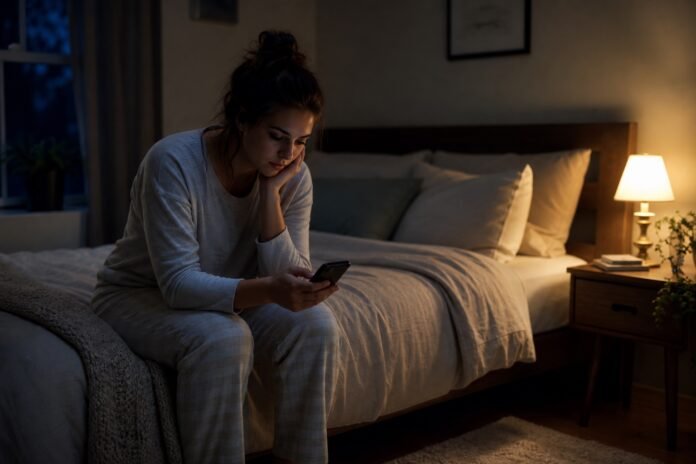
It’s 12:40am. You said 11. You have known since about 11:20 that you were going to be tired tomorrow, and you have watched yourself keep going anyway, one more episode, one more scroll, one more small thing that isn’t sleep. Nobody is keeping you up. There’s no deadline, no baby, no shift. The bed is right there. You just haven’t gone to it, and you couldn’t fully explain why if someone asked.
That gap between the bedtime you intended and the one you took has a name, a decade of research behind it, and a set of explanations considerably more interesting than “you have no self-discipline.” Here’s what’s happening in that hour, why the standard advice about screens and routines keeps missing, and what the evidence suggests works instead.
It has a name, and the definition is precise
In 2014, a Dutch team led by Floor Kroese gave the behaviour a formal label. Bedtime procrastination is failing to go to bed at the intended time, while no external circumstances prevent a person from doing so (Kroese et al., 2014).
Two conditions have to be met. You have to have intended an earlier bedtime, and nothing outside you can be stopping you. A night shift isn’t bedtime procrastination. Neither is a sick child, a delayed flight, or insomnia, where you’re in bed and sleep won’t come.
The definition deliberately echoes the general one for procrastination: voluntarily delaying an intended action while expecting to be worse off for the delay. Which makes bedtime procrastination a strange member of the family. Most procrastination is about avoiding a task. This one is about avoiding the end of the day, and the thing being put off is rest.
Kroese’s framing placed it in the health-behaviour literature rather than the productivity one, which was the right call. The cost isn’t a missed deadline. It’s sleep.
It’s still procrastination in the technical sense, though, and it inherits the same machinery. If you delay at bedtime you probably delay elsewhere too, and our guide to why you procrastinate covers the mechanism that both share. A systematic review and meta-analysis has since pulled together what bedtime procrastination is associated with, and the picture is consistent: worse sleep outcomes across the board (Hill et al., 2022).
It’s close to universal
A 2026 study tracked residential college students with daily diaries paired with actigraphy, so bedtimes were measured rather than remembered. Students went to bed later than intended on 54% of all nights, and 99% did it at least once over two weeks (Kok et al., 2026).
Ninety-nine per cent. Whatever this is, it isn’t a minority failing.
The same study asked why. The most common answer wasn’t rebellion or reward, it was simply losing track of time, at 32.6%. Wanting “me” time came second, at 20%. That ordering matters, because most writing on this topic assumes the second answer is the whole story.
What it costs by morning
Here’s the part that undercuts the usual reassurance about catching up later.
The actigraphy showed students losing 50 to 60 minutes of sleep on both school and non-school nights, because wake-up times stayed relatively fixed. They didn’t sleep in to compensate. The hour was simply gone.
Delaying bedtime was associated with roughly double the odds of next-day sleepiness, along with measurable increases in negative mood and decreases in positive mood. And the effect held regardless of chronotype, which is worth noting, because “I’m just a night owl” is the most common way people explain the pattern to themselves.
Scale that up and it stops looking trivial. CDC data for 2024 put 30.5% of US adults at under seven hours of sleep in a typical 24-hour period, against a recommendation of seven or more. Bedtime procrastination isn’t the only reason for that number, but it’s one of the few reasons that’s entirely inside the individual’s control and still somehow not.
“Revenge bedtime procrastination” is a feeling with a borrowed name
The phrase entered English in June 2020, when a journalist translated the Chinese internet expression 報復性熬夜 on Twitter. It spread quickly because it named something people recognised: staying up late to reclaim hours that the working day took from you.
Worth being straight about what it is. That phrase came from social media, not from a laboratory. There’s no revenge bedtime procrastination scale, no prevalence estimate, no separate literature. When researchers write about it, they’re usually mapping it onto something they already had a name for.
That’s not a debunking. The experience is real and the phrase captures it better than the academic vocabulary does. It’s just useful to know which parts of what you’re reading were measured and which were coined.
The three varieties that were measured
Sanne Nauts and colleagues interviewed chronic bedtime procrastinators in depth and sorted their own explanations into three kinds (Nauts et al., 2019).
Deliberate procrastination is knowingly postponing sleep to reclaim personal time. This is the one “revenge bedtime procrastination” describes. You are aware of the trade and you make it anyway, because the alternative is a day with nothing in it that was yours.
Mindless procrastination is losing track. There was no decision to stay up, and there was no moment where you weighed anything. You surfaced at 12:40 and the time had gone. Given the 32.6% figure above, this is probably the most common form and it gets written about the least.
Strategic delay is putting off bed because bed itself has become unpleasant. This shows up especially in people who lie awake, where the bedroom has come to mean frustration rather than rest. Delaying until you’re certain of falling asleep is a rational response to that history. If this is you, our guide to sleep anxiety is the more relevant page, and the approach that helps is different.
Three different problems. One behaviour. Advice aimed at the wrong one will feel useless, which it will be.
Why willpower is the wrong frame
The obvious explanation is that you lack self-control at night. The research complicates that in a helpful way.
Bart Kamphorst and colleagues looked at what people had spent the day doing rather than what they were like as people. Participants who had resisted more desires across the day were more likely to delay bedtime that night (Kamphorst et al., 2018). Self-regulation behaved like a resource being drawn down, and bedtime is when the account is emptiest.
Which reframes the 12:40am version of you. That person isn’t the weak one. That person is the one who has already spent the day not saying the thing, not eating the thing, not sending the email, staying pleasant in a meeting that didn’t deserve it. The restraint was all used earlier, on things you don’t get credit for.
Worth saying plainly, since this is where people reach for the harshest available word: none of this is laziness, which isn’t a psychological construct in the first place. Staying up is an active choice made by a depleted person, not an absence of effort.
The field has been moving further in this direction. A 2026 editorial in Sleep argued for treating bedtime procrastination as a set of momentary motivations rather than a binary willpower failure, and for asking what unmet need the behaviour is meeting (Suh, 2026). That’s a more workable question than asking why you can’t just go to bed.
It also explains why the standard advice underperforms. Sleep hygiene assumes the problem is knowledge. You already know. The problem is that at 11:40pm, going to bed costs something, and nothing in a sleep hygiene checklist addresses what.
The night owl question
Chronotype does matter. A daily diary study of 108 employees found eveningness and depleted self-control both linked to greater bedtime procrastination (Kühnel et al., 2018), and if your body genuinely wants to sleep later, an 11pm target is a fight you didn’t need to pick.
But it isn’t a full defence, and the 2026 actigraphy data is the reason. Bedtime procrastination predicted sleep loss regardless of chronotype. Being an evening type makes the delay more likely; it doesn’t make the lost hour cheaper, because the alarm still goes at the same time.
The practical read: use chronotype to set a realistic target, not to justify an unbounded one.
What helps: decide what the evening is for
If a fifth of people are staying up for “me” time, then an evening with no personal time in it will be taken back at midnight, every time. Willpower can’t beat a genuine unmet need indefinitely.
So the move is to put the thing you’re staying up for somewhere earlier, deliberately, and to make it count as the thing rather than as a warm-up. Forty protected minutes at 8pm that you actually enjoy will do more for your bedtime than any amount of resolve at eleven.
This is the reverse of most sleep advice, which tries to subtract from the evening. Subtraction is what created the debt.
What helps: protect the wake time first
Since the sleep loss comes from fixed wake times meeting variable bedtimes, the wake time is the load-bearing part of the schedule.
Keeping it steady, including at weekends, is what stops a late night from becoming a rolling pattern. It feels like the punishing option and it’s the one that limits the damage, because a lie-in shifts tonight’s sleepiness later and makes the next delay easier.
Set the wake time you can hold on a normal week, then work backwards to a bedtime that isn’t aspirational.
What helps: move the decision earlier
Mindless procrastination doesn’t involve a decision at midnight, so a rule made at midnight has nothing to attach to.
Put the friction at the start of the evening instead, when you still have something to spend. Decide how many episodes before the first one. Charge the phone in another room at nine rather than negotiating with yourself at eleven. Set an alarm for the start of the wind-down instead of for bedtime.
Each of these is a decision made by the version of you who is not depleted, imposed on the version who will be. That’s the whole trick, and it works precisely because it doesn’t rely on willpower at the moment willpower is gone.
What helps: name the need underneath
Ask what the last hour is doing for you. Rest, autonomy, escape, connection, or the feeling of a day that contained something you chose. Whatever it is, it’s a legitimate need being met badly and expensively.
Then ask whether the need has anywhere else to go. Sometimes it does and the fix is scheduling. Sometimes it doesn’t, and the honest answer is that a life with no room in it will keep taking the room from your sleep, which is a bigger conversation than a bedtime.
If most nights end with your body wired and unwilling to settle, our guide to nervous system regulation covers the physiology of that and why it takes time to come down.
When to talk to a professional
Worth raising with someone if you regularly lie awake once you do go to bed, if daytime tiredness is affecting your work, driving or mood, if the late hours come with low mood or anxiety that’s been building, or if you’ve been running on under six hours for months.
Insomnia and bedtime procrastination look similar from outside and need different treatment, and cognitive behavioural therapy for insomnia is well established for the former. A clinician can tell you which one you’re dealing with, which is not always obvious from the inside.
The takeaway
Almost everyone does this. Ninety-nine per cent of students in a two-week study, on more than half of all nights, and the most common reason wasn’t defiance or self-sabotage but simply losing track of the time.
The version of you at 12:40am has usually spent the whole day being disciplined about other things. What’s left at that hour isn’t character, and treating it as character is why the advice you’ve been given hasn’t held. The behaviour is meeting a need, and needs respond to being met, not to being scolded.
Give the evening something of its own, keep the morning steady, and make the decision while you still have one to make. The hour you’re trying to reclaim is worth having. It just doesn’t have to come out of tomorrow.
If the late nights come with something heavier
When staying up is tangled with anxiety, low mood, or a working life that leaves no room in it, the bedtime is a symptom rather than the problem. Therapy can help with both the sleep pattern and what’s driving it, and CBT-based approaches have strong support for sleep difficulties specifically. Our guide to finding the right therapist covers what to look for and how to start.
Frequently asked questions
What is bedtime procrastination?
Going to bed later than you intended when nothing external is preventing you. The definition requires both parts: you meant to sleep earlier, and no outside circumstance stopped you. A night shift, a sick child or lying awake with insomnia are all something else.
Is revenge bedtime procrastination a real condition?
It’s a real experience with an internet name. The phrase came into English in 2020 as a translation of a Chinese social media expression, not from research. Researchers describe something similar as deliberate bedtime procrastination, meaning knowingly postponing sleep to reclaim personal time.
How much sleep does bedtime procrastination actually cost?
In a 2026 study using actigraphy, students lost 50 to 60 minutes on both school and non-school nights, because wake-up times stayed fixed rather than shifting later. Delaying bedtime was also associated with roughly double the odds of next-day sleepiness and worse next-day mood.
Am I just a night owl?
Chronotype does play a role, and evening types are more prone to delaying bedtime. But daily data found bedtime procrastination predicted sleep loss regardless of chronotype, because the alarm doesn’t move. Being an evening type is a reason to set a later realistic target, not an unlimited one.
Why doesn’t sleep hygiene advice work for me?
Most sleep hygiene assumes the problem is not knowing what to do. Research increasingly frames bedtime procrastination as meeting an unmet need, often autonomy or rest, at a point in the day when self-regulatory resources are lowest. Advice that ignores the need tends not to survive contact with 11pm.
Sources
- Centers for Disease Control and Prevention, National Center for Health Statistics. Short sleep duration and sleep difficulties among adults: United States, 2024. NCHS Data Brief, 559. Link
- Hill, V. M., Rebar, A. L., Ferguson, S. A., Shriane, A. E., & Vincent, G. E. (2022). Go to bed! A systematic review and meta-analysis of bedtime procrastination correlates and sleep outcomes. Sleep Medicine Reviews, 66, 101697. Link
- Kamphorst, B. A., Nauts, S., De Ridder, D. T. D., & Anderson, J. H. (2018). Too depleted to turn in: The relevance of end-of-the-day resource depletion for reducing bedtime procrastination. Frontiers in Psychology, 9, 252. Link
- Kok, V. J., Chua, S., Yabuki, H., Rukmini, A. V., Sreenivasulu, B., & Gooley, J. J. (2026). Going to bed later than intended is associated with shorter sleep and poorer next-day mood and sleepiness in residential college students. Sleep, 49(5), zsaf414. Link
- Kroese, F. M., De Ridder, D. T. D., Evers, C., & Adriaanse, M. A. (2014). Bedtime procrastination: Introducing a new area of procrastination. Frontiers in Psychology, 5, 611. Link
- Kühnel, J., Syrek, C. J., & Dreher, A. (2018). Why don’t you go to bed on time? A daily diary study on the relationships between chronotype, self-control resources and the phenomenon of bedtime procrastination. Frontiers in Psychology, 9, 77. Link
- Nauts, S., Kamphorst, B. A., Stut, W., De Ridder, D. T. D., & Anderson, J. H. (2019). The explanations people give for going to bed late: A qualitative study of the varieties of bedtime procrastination. Behavioral Sleep Medicine, 17(6), 753–762. Link
- Suh, S. (2026). Why we postpone sleep: Bedtime procrastination beyond self-control failure. Sleep, 49(5), zsag061. Link
This article is for educational and informational purposes only and is not a substitute for professional medical or mental health advice, diagnosis, or treatment. Always seek the guidance of a qualified mental health professional with any questions about your mental health or a medical condition.
