Key Takeaways
- When researchers need to reliably trigger a stress response in a laboratory, they stage a mock job interview. The design works.
- Across studies, interview anxiety correlates with lower interview scores at roughly r = -.19: a real effect, but a modest one.
- Interview anxiety shows near-zero correlation with how people later perform in the job itself. The interview is measuring something else.
- Interviewers largely miss your nervous tics. What moves their ratings is how warm and assertive you come across.
- Treating a racing heart as fuel rather than as failure improves stress responses, and you can do it in the waiting room.
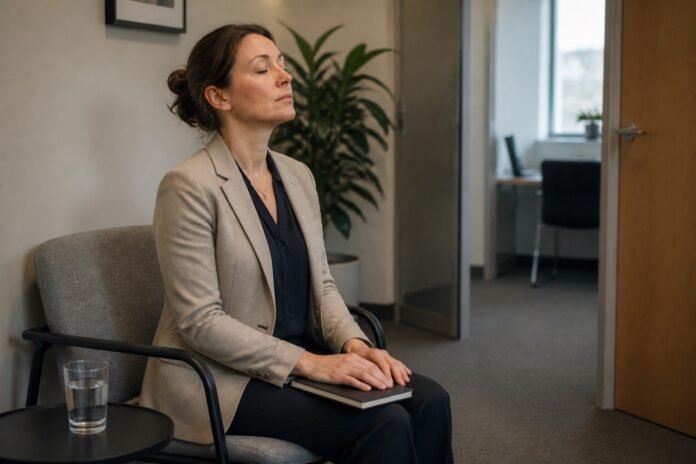
You’re in the car park eleven minutes early, which felt like good planning at home and now feels like eleven minutes with nothing to do. You’ve read the job description four times. Your hands are cold. You’re running your answer to “tell me about yourself” one more time, and this time it comes out worse than it did in the shower, so you run it again. Underneath all of it sits a quiet suspicion that everyone else walks into these rooms feeling normal, and that whatever your body is doing right now is evidence of something wrong with you.
It isn’t. The research on this is unusually clear, and it points somewhere more useful than “just be confident.” A job interview is one of the most reliable stressors psychologists have ever built, your anxiety costs you less than you fear, and the thing interviewers respond to isn’t the thing you’re braced about. Below is what’s happening in your body, what the evidence says it does to your ratings, and five things you can do that follow from the findings rather than from folklore.
Psychologists use job interviews to create stress on purpose
Start with the fact that reframes everything else. Since 1993, the standard way to reliably induce a stress response in a human research participant has been a procedure called the Trier Social Stress Test, developed by Clemens Kirschbaum and colleagues at the University of Trier (Kirschbaum, Pirke, & Hellhammer, 1993). Researchers needed something that would spike stress hormones dependably, in almost anyone, in a controlled setting.
What they built was a job interview.
Participants are told they’re candidates for their ideal job. They get ten minutes to prepare a five-minute speech arguing why they’re the best person for the role. They deliver it to a panel introduced as trained to assess non-verbal behaviour, who are instructed to stay unresponsive and give nothing back. Then, without warning, they’re asked to do mental arithmetic out loud.
The original paper reported that this protocol produced two- to four-fold increases in salivary cortisol above baseline, along with significant rises in ACTH, growth hormone, prolactin, and heart rate, across six independent studies. It has since become the most widely used laboratory stress paradigm in the field.
So when your heart rate climbs in a waiting room, you’re not malfunctioning. You’re producing the exact response that a carefully engineered stressor was designed to produce, in a situation that contains every ingredient the designers included: evaluation by strangers, uncontrollability, and a threat to your social standing. If you want the physiology in more depth, our guide to nervous system regulation covers what your body is doing and why it takes a while to come down.
Interview anxiety isn’t one thing
Most advice treats interview nerves as a single lump of feeling. The measurement research doesn’t. When Julie McCarthy and Richard Goffin built the Measure of Anxiety in Selection Interviews, they found the experience separates cleanly into five distinct dimensions (McCarthy & Goffin, 2004):
- Communication anxiety. Worry about speaking: losing your thread, stumbling, going blank.
- Appearance anxiety. Worry about how you look and what that signals.
- Social anxiety. Worry about being judged as a person rather than as a candidate.
- Performance anxiety. Worry about the outcome and what failing would mean.
- Behavioural anxiety. Worry about what your body is visibly doing.
Their five scales together produced a multiple correlation of .34 with interview performance, developed on a student sample and then tested with 276 real job applicants in the field. That matters practically, because the five don’t respond to the same fixes. Rehearsing answers helps communication anxiety and does almost nothing for social anxiety. Reappraising your physical arousal helps behavioural anxiety and won’t touch your worry about the outcome.
Generic interview advice fails partly because it aims at all five at once and lands on none of them.
What the anxiety costs you, in numbers
Deborah Powell, David Stanley, and Kayla Brown pooled the available studies on self-reported interview anxiety and interview performance. The overall correlation was -.19, moderated by how anxiety was measured and by whether the interview was a mock or a real one (Powell, Stanley, & Brown, 2018).
Worth sitting with what a correlation of that size means. It’s a real relationship, reliably detected, and it’s modest. Anxiety accounts for a small share of the variation in how candidates get rated. Most of what determines your score is something else: your experience, your answers, the fit, the other candidates, the interviewer’s own judgment.
Which is to say the story you may be telling yourself, that your nerves are the reason you didn’t get the last three jobs, is probably overstating a real effect. The nerves are not helping. They are also not the main event.
One honest caveat about this literature. A large share of the best work on interview anxiety comes from a small number of research groups, several of them connected to the same lab at the University of Guelph. That’s normal for a narrow specialism, and it’s a reason to hold the precise numbers loosely even while the overall direction looks solid.
The finding that should change how you prepare
Here’s the result that gets left out of nearly every article on this topic.
Lisa Schneider, Deborah Powell, and Silvia Bonaccio followed applicants for Residence Assistant positions from their selection interviews through to the job itself, then collected performance ratings from both supervisors and the people they supervised. Interview anxiety had near-zero correlations with job performance (Schneider, Powell, & Bonaccio, 2019).
They also found something sharper. Among highly anxious candidates, interview performance stopped predicting job performance on at least one dimension. For those applicants, the interview wasn’t measuring their capability. It was measuring their anxiety.
Read that in your own favour, because it’s the accurate reading. If interviews go badly for you and the work goes well once you’re in the role, that isn’t a story you’re telling yourself to feel better. It’s a documented pattern. The interview is a specific performance, under a specific kind of pressure, that a well-designed laboratory stressor happens to replicate almost exactly. Being bad at it is not evidence of being bad at the job.
This is also a reasonable thing to name in the room, briefly and without apology, if you want to.
What interviewers notice, and what they miss
Most people preparing for an interview are quietly managing a list of physical tells: the shaking hands, the flushed neck, the voice doing something strange on the first answer. Alexandra Feiler and Deborah Powell filmed 119 mock interviews with 18 professional interviewers from a Canadian co-op placement service, then had trained raters code the footage for verbal and non-verbal cues (Feiler & Powell, 2016).
Very few behavioural cues tracked with how anxious candidates said they felt, and only three tracked weakly with how anxious the interviewers thought they were: lip licking or biting, shifting the torso, and slower speech. The likely reason so little showed up is that anxiety looks different in different people. One person goes still and hesitant, another gets fast and fidgety, so there’s no consistent signal for an interviewer to read.
What did predict lower ratings was a pair of trait impressions: assertiveness and interpersonal warmth. Candidates who came across as less assertive and less warm were both rated as more anxious and scored lower on performance, and those two impressions statistically explained the link between anxiety and the ratings.
The practical translation is close to a relief. Your hands are not the problem. Nobody is scoring your hands. What costs you is the way anxiety flattens you into someone quieter and cooler than you are.
Step 1: Work out which of the five you’re dealing with
Before preparing anything, spend two minutes identifying which dimension is loudest for you. The test is simple: picture the interview and notice what the dread attaches to. Going blank mid-answer? Communication. Being seen as a person and found wanting? Social. Not getting the job and what that would mean? Performance.
Most people find one or two dominate. That’s your target. Preparation aimed at the wrong dimension feels productive and changes nothing, which is why some people rehearse for eight hours and still walk in feeling exactly as they did before. They fixed a problem they didn’t have.
Step 2: Reframe the arousal instead of fighting it
The instinct is to calm down. The evidence suggests a different move.
Jeremy Jamieson, Matthew Nock, and Wendy Berry Mendes randomly assigned participants either to reappraise their physical arousal as functional and helpful, or to control conditions, before a stressful task. The reappraisal group showed more adaptive cardiovascular responses, including increased cardiac efficiency and lower vascular resistance, plus reduced attentional bias toward threat (Jamieson, Nock, & Mendes, 2012).
They weren’t less aroused. They were aroused differently, in a pattern that resembles being challenged rather than being threatened.
In practice this is a sentence you say to yourself when you notice your heart going, and it needs to be specific rather than positive: this is my body sending blood and oxygen to my brain so I can think faster, which is what it’s supposed to do before something that matters. That’s not a mantra. It’s an accurate description of what elevated cardiac output is for. Trying to suppress the arousal tends to add a second problem, because now you’re managing your anxiety and your interview at once.
Step 3: Over-prepare content, because speech is the cue that leaks
Of the three behavioural cues interviewers picked up on, slower speech was the one most within your control, and it has an obvious cause: retrieving an answer you haven’t formulated takes time, and the pauses show.
So prepare the substance rather than the delivery. Have four or five concrete stories ready with enough detail that you can tell them without searching: what the situation was, what you did, what happened. Not scripts, which sound like scripts, but material solid enough that you’re recalling rather than constructing. It fixes the one tell that reads accurately, and it happens to be the fix for communication anxiety too.
Practising out loud matters more than practising in your head, because the retrieval you’re rehearsing is verbal.
Step 4: Plan for warmth, not just competence
Since warmth and assertiveness are what move the ratings, they deserve the same preparation you’d give a technical question, and almost nobody gives them any.
Warmth is mostly small mechanics: asking the interviewer something and responding to what they say, letting an answer be a conversation rather than a delivery, allowing yourself to be visibly interested in the work. Assertiveness is mostly about taking up your share of the space: finishing your point rather than trailing off, saying “I led that” when you led it, letting a considered pause be a pause instead of filling it.
Both erode under anxiety by default, which is exactly why they’re worth deciding on in advance. If you know that nerves make you smaller, you can plan one or two specific counterweights rather than hoping you’ll feel differently on the day.
Step 5: Give the waiting period something to do
In the Trier protocol, the ten-minute anticipation phase isn’t dead time. It’s part of the stressor, and researchers include it because waiting while you prepare is itself potent.
Your car park eleven minutes are the same phase, and they’re doing the same work. Running your answers again during them mostly generates evidence that your answers are getting worse, because rehearsing under acute arousal makes retrieval feel harder than it will be in the room.
Better uses: a slow walk, a phone call to someone about something unrelated, the reappraisal sentence from step two, or reading the job description one final time and then deliberately closing it. The goal isn’t to feel calm. It’s to stop the anticipation phase from compounding.
When interview anxiety is part of something larger
For some people, interviews are one instance of a much broader pattern of fear around being evaluated. Researchers have specifically examined fear of negative evaluation as a shared root of both interview anxiety and social-evaluative anxiety at work (Zhang, Powell, & Bonaccio, 2022), and that root has a clinical form.
Social anxiety disorder involves persistent fear of social or performance situations where you might be scrutinised, along with fear of acting in a way that will be humiliating. An estimated 7.1% of US adults met criteria in the past year and 12.1% will at some point in life, with the highest past-year rates in the 18 to 29 and 30 to 44 age brackets, at 9.1% and 8.7% (National Institute of Mental Health).
Those criteria exist so clinicians can agree with each other, not as a bar your distress has to clear before it counts. If interviews are one item on a longer list that includes meetings, phone calls, and social events, it’s worth reading our guide to social anxiety, or the more direct do I have social anxiety. If you’re unsure whether what you’re describing is anxiety or temperament, social anxiety versus shyness versus introversion is the more useful place to start. And if the dread extends well past interviews into the job itself, that’s work anxiety rather than interview anxiety, and it responds to different things.
If evaluation anxiety runs wider than interviews
Cognitive behavioural therapy with a graded exposure component has the strongest evidence base for social and performance anxiety, and interview anxiety tends to improve as part of that broader work rather than on its own. Our guide to finding the right therapist covers what these approaches involve, what they typically cost, and how to start. You don’t have to keep organising your career around avoiding rooms with panels in them.
The takeaway
The reason interviews feel disproportionate is that they are disproportionate. Being evaluated by strangers who give you nothing back, with an outcome you can’t control and your standing on the line, is a combination that psychologists selected precisely because it works on almost everyone. Your nervous system is reading the situation correctly.
What the evidence adds is proportion. Anxiety nudges your ratings rather than deciding them. It doesn’t predict how you’ll do in the job, and among the most anxious candidates the interview can stop predicting job performance altogether. The tells you’re monitoring are mostly invisible. The thing that actually costs you is subtler and more fixable: anxiety makes you seem colder and smaller than you are, and you can prepare against that specifically.
You’re not trying to walk in unafraid. Nobody does. You’re trying to walk in as recognisably yourself, with the fear along for the ride.
Frequently asked questions
Does interview anxiety mean I’m not ready for the job?
No. Research following applicants from interview into the role found near-zero correlations between interview anxiety and later job performance rated by supervisors and supervisees. Among highly anxious candidates, interview performance stopped predicting job performance on at least one dimension, meaning the interview measured the anxiety rather than the capability.
Can interviewers tell how nervous I am?
Less than you think. In a study of 119 filmed mock interviews, only three behavioural cues tracked weakly with interviewer perceptions of anxiety: lip licking or biting, torso shifts, and slower speech. Shaking hands and similar tells did not register. What interviewers responded to was how warm and assertive candidates seemed.
How much does anxiety actually lower my interview score?
A meta-analysis pooling the available studies found a correlation of about -.19 between self-reported interview anxiety and interview performance. That’s a real but modest effect, meaning anxiety explains a small share of the variation in ratings. Most of what determines your score is your experience, your answers, and the fit.
Should I try to calm down before an interview?
Reframing the arousal tends to work better than suppressing it. In randomised research, participants told to view their physical arousal as functional showed more adaptive cardiovascular responses and less attentional bias toward threat. They weren’t calmer, but their bodies responded in a challenge pattern rather than a threat pattern.
When does interview anxiety become social anxiety disorder?
When the fear of being evaluated extends well beyond interviews into meetings, phone calls, and social situations, and interferes with daily life. An estimated 7.1% of US adults meet criteria for social anxiety disorder in a given year. Only a clinician can assess this, and diagnostic thresholds exist for consistency rather than as a bar your distress must clear.
Sources
- Feiler, A. R., & Powell, D. M. (2016). Behavioral expression of job interview anxiety. Journal of Business and Psychology, 31(1), 155–171. Link
- Jamieson, J. P., Nock, M. K., & Mendes, W. B. (2012). Mind over matter: Reappraising arousal improves cardiovascular and cognitive responses to stress. Journal of Experimental Psychology: General, 141(3), 417–422. Link
- Kirschbaum, C., Pirke, K. M., & Hellhammer, D. H. (1993). The ‘Trier Social Stress Test’: A tool for investigating psychobiological stress responses in a laboratory setting. Neuropsychobiology, 28(1–2), 76–81. Link
- McCarthy, J., & Goffin, R. (2004). Measuring job interview anxiety: Beyond weak knees and sweaty palms. Personnel Psychology, 57(3), 607–637. Link
- National Institute of Mental Health. Social anxiety disorder statistics. Link
- Powell, D. M., Stanley, D. J., & Brown, K. N. (2018). Meta-analysis of the relation between interview anxiety and interview performance. Canadian Journal of Behavioural Science, 50(4), 195–207. Link
- Schneider, L., Powell, D. M., & Bonaccio, S. (2019). Does interview anxiety predict job performance and does it influence the predictive validity of interviews? International Journal of Selection and Assessment, 27(4), 328–336. Link
- Zhang, I. Y., Powell, D. M., & Bonaccio, S. (2022). The role of fear of negative evaluation in interview anxiety and social-evaluative workplace anxiety. International Journal of Selection and Assessment, 30(2), 302–310. Link
This article is for educational and informational purposes only and is not a substitute for professional medical or mental health advice, diagnosis, or treatment. Always seek the guidance of a qualified mental health professional with any questions about your mental health or a medical condition.
