Key Takeaways
- Backdraft is the name for old pain surfacing when you first treat yourself kindly. It’s a recognised pattern, not a sign you’re doing it wrong.
- The term is a firefighting metaphor: open a door on an oxygen-starved fire and flames rush out.
- Backdraft itself is barely researched. A 2024 commentary in Mindfulness called it an overlooked yet vital research focus (Cai, 2024).
- What is well evidenced is the neighbouring construct: fear of self-compassion, measurable and tracking with self-criticism, shame and depression across 4,723 people (Kirby et al., 2019).
- The practical implication is counterintuitive. Smaller doses of kindness, not bigger ones, are how you get past it.
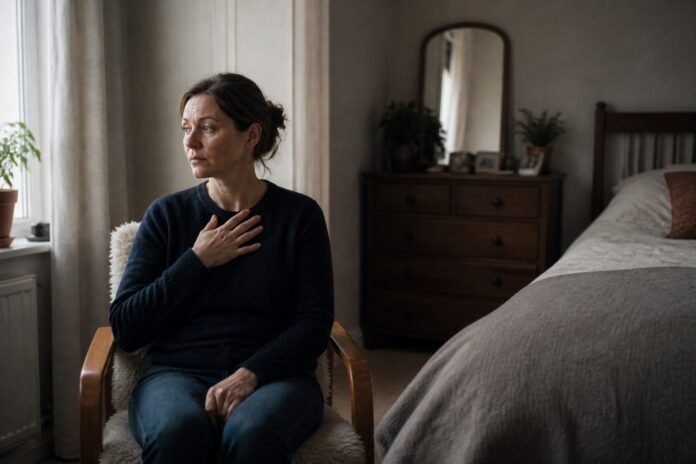
You did the exercise. Hand on your chest, the phrase about this being a moment of difficulty, the bit about being kind to yourself the way you’d be kind to a friend.
And instead of feeling soothed you felt your throat tighten, or a wave of anger arrive from nowhere, or an urge to stop that was close to panic. So you concluded self-compassion isn’t for you, filed it with the other things that work for other people, and went back to the way you were managing before.
That reaction has a name, and the people who teach this expect it.
What backdraft means
The term comes from firefighting. A fire burning in a closed room consumes the available oxygen and dies down to smouldering. Open the door and fresh air rushes in, and the fire explodes outward through the opening.
Chris Germer brought the metaphor into self-compassion teaching to describe something teachers kept seeing. When people who have been harsh with themselves for years first offer themselves warmth, the warmth goes in and old pain comes out with it.
It shows up as grief, anger, numbness, physical tension, or an urgent need to stop. What it doesn’t feel like is relief, which is what you were promised and what makes the experience so disorienting.
Being honest about the evidence
Here’s where most articles on this would tell you backdraft is a well-established phenomenon. It isn’t, and the gap is worth knowing about.
A 2024 commentary in Mindfulness made exactly this point, describing backdraft as an overlooked yet vital research focus and noting that empirical studies examining it specifically are lacking (Cai, 2024). It’s a clinical observation that has been taught for over a decade without being directly tested.
So the honest position: the pattern is consistently reported by people who teach self-compassion and by people who practise it, and the mechanism proposed for it is plausible. It has not been measured.
What has been measured is close enough to be useful.
Fear of self-compassion is real and measurable
Paul Gilbert and colleagues built scales for something adjacent: fear of compassion, in three directions. Fear of compassion for yourself, fear of receiving it from others, and fear of extending it to others (Gilbert et al., 2011).
Fear of self-compassion turned out to correlate with self-coldness, self-criticism, insecure attachment, and with depression, anxiety and stress. It’s not rare and it’s not a quirk. It’s a measurable individual difference concentrated in exactly the people who would benefit most.
A meta-analysis pooled 19 studies, 154 effect sizes and 4,723 participants using those scales, and found fears of compassion strongly associated with depression, shame and self-criticism (Kirby et al., 2019).
Read what that implies. The more harshly you treat yourself, the more likely kindness is to feel threatening. The difficulty is not evidence that self-compassion is wrong for you. It’s a marker of how much you need it.
Why kindness would feel like a threat
Three explanations are commonly offered, and they aren’t mutually exclusive.
Contrast. Warmth makes the absence of warmth legible. If you’ve been running on self-criticism, you may not have registered how much it hurt until something gentler arrived and gave you a comparison. The pain was there. The kindness made it visible.
Association. If comfort in your history came with conditions, or arrived unpredictably, or came from someone who also caused harm, then warmth is not a neutral signal. Your system learned to treat it as the opening move in something that ends badly.
Loss of a defence. Self-criticism does a job. It can feel like control, like staying ahead of other people’s judgment, like the thing keeping you functional. Setting it down is not only relief, it’s exposure, and some of what surfaces is the fear of what happens without it.
Our guide to where the harsh voice comes from covers that last one in depth, because the defence is usually older than the job it’s currently doing.
What to do when it happens
The instinct is to push through, on the theory that the discomfort is resistance to be overcome. That’s the wrong model and it makes things worse.
Reduce the dose. This is the central move and it’s counterintuitive. If a full self-compassion practice produces backdraft, the answer isn’t a longer practice, it’s a smaller one. Thirty seconds. One phrase. Warmth directed at your hands rather than at your whole self.
Move toward the body and away from the words. Feet on the floor, the temperature of the air, the weight of you in the chair. Grounding is not giving up on the practice, it’s what makes returning to it possible.
Stop when you need to. Ending a practice that has become overwhelming is a skill, not a failure of one. The point is to build a tolerable relationship with your own kindness, and forcing past your limit teaches the opposite lesson.
Expect it to be uneven. Backdraft doesn’t arrive once and resolve. It tends to come in waves as different material becomes available.
Where the line is
Most backdraft is uncomfortable and survivable. Some of it isn’t, and the distinction matters more than anything else here.
The 2024 commentary made a point worth repeating: understanding backdraft properly means drawing on the literature about adverse effects of meditation practices, which is a real body of work rather than a fringe concern (Cai, 2024). Contemplative practice can destabilise some people, particularly those with trauma histories.
Stop and get support rather than continuing alone if practice reliably produces dissociation, if it opens material connected to trauma, if distress persists long after you’ve stopped, or if it triggers thoughts of harming yourself.
None of that means self-compassion is unavailable to you. It means the unguided version is the wrong delivery mechanism, and a person in the room changes what’s possible.
Does the programme work if this happens?
Reasonably, you might wonder whether the whole approach is worth the trouble.
The Mindful Self-Compassion programme, the eight-week course where backdraft is explicitly taught, has been tested. A pilot study and randomised controlled trial found the experimental group showed significant improvements in self-compassion, mindfulness and wellbeing while controls changed minimally (Neff & Germer, 2013).
Two things follow. Backdraft occurring inside a programme that produces measurable benefit is not evidence the programme fails. And the course teaches backdraft as expected rather than exceptional, which is itself the useful information: nobody running these groups is surprised when it happens.
When to talk to a professional
Self-compassion is a skill rather than a diagnosis, and there’s no threshold to clear before working on it is worthwhile.
Worth raising with someone qualified: if kindness toward yourself reliably produces distress rather than relief, if what surfaces connects to experiences you haven’t worked through, or if the self-criticism sits alongside persistent low mood. Given what the fear-of-compassion research shows, difficulty here is a signal to get support rather than to try harder alone.
If kindness keeps opening something you can’t hold
Backdraft is more manageable with someone in the room, and what surfaces is often material worth working through rather than material to get past. A therapist can pace it, and can tell the difference between discomfort that’s part of the process and distress that isn’t. Our guide to finding the right therapist covers what to look for, what it tends to cost, and how to start without a referral.
The takeaway
If being kind to yourself hurt, you didn’t fail at it. You ran into something the people who teach this have a name for and expect.
The evidence picture is honest rather than tidy: backdraft itself is under-researched, while the adjacent construct of fear of self-compassion is well measured and points the same direction. Both say the same practical thing, which is that difficulty here correlates with need rather than unsuitability.
The move is smaller doses, not more determination. Our complete guide to self-compassion covers the practices themselves, and quieting the inner critic is often the gentler entry point when direct kindness is too much.
Frequently asked questions
What is backdraft in self-compassion?
The surfacing of old pain when someone who has been harsh with themselves first offers themselves warmth. The name comes from firefighting, where opening a door on an oxygen-starved fire causes flames to rush out. It shows up as grief, anger, numbness or an urgent need to stop.
Why does being kind to myself feel bad?
Three explanations are usually offered: warmth makes the absence of warmth legible by contrast; comfort may be associated with unreliability or harm in your history; and self-criticism may be doing a protective job that feels unsafe to set down. Research on fear of self-compassion shows this difficulty concentrates among people high in self-criticism.
Is backdraft scientifically proven?
Not directly. A 2024 commentary in Mindfulness described it as an overlooked yet vital research focus and noted that empirical studies examining it specifically are lacking. The adjacent construct of fear of self-compassion is well measured, with a meta-analysis of 4,723 participants linking it to depression, shame and self-criticism.
Should I push through backdraft?
No. Pushing through treats the discomfort as resistance to overcome, which tends to make it worse. Reducing the dose works better: a shorter practice, a single phrase, or warmth directed at your hands rather than your whole self. Stopping when you need to is a skill rather than a failure.
When should I stop practising self-compassion on my own?
If practice reliably produces dissociation, opens material connected to trauma, leaves distress that persists long after you stop, or triggers thoughts of harming yourself. That does not mean self-compassion is unavailable to you, only that the unguided version is the wrong delivery mechanism and support would change what is possible.
Sources
- Cai, R. Y. (2024). Backdraft in self-compassion: an overlooked yet vital research focus. Mindfulness, 15, 716–720.
- Gilbert, P., McEwan, K., Matos, M., & Rivis, A. (2011). Fears of compassion: development of three self-report measures. Psychology and Psychotherapy: Theory, Research and Practice, 84(3), 239–255.
- Kirby, J. N., Day, J., & Sagar, V. (2019). The ‘flow’ of compassion: a meta-analysis of the fears of compassion scales and psychological functioning. Clinical Psychology Review, 70, 26–39.
- Neff, K. D., & Germer, C. K. (2013). A pilot study and randomized controlled trial of the Mindful Self-Compassion program. Journal of Clinical Psychology, 69(1), 28–44.
- Germer, C. K. (2009). The Mindful Path to Self-Compassion. Guilford Press. (Origin of the backdraft metaphor in self-compassion teaching.)
- Neff, K. D. (2003). The development and validation of a scale to measure self-compassion. Self and Identity, 2(3), 223–250.
Disclaimer: This article is for educational and informational purposes only and is not a substitute for professional medical or mental health advice, diagnosis, or treatment. Contemplative practices can be destabilising for some people, particularly those with trauma histories. Always seek the advice of a qualified professional with any questions about your mental health.
If you’re struggling or in crisis
US: Call or text 988 (Suicide & Crisis Lifeline), 24/7, free and confidential.
UK & ROI: Call 116 123 (Samaritans), free, 24/7.
International: Find a helpline at findahelpline.com.
